
So before I start this post I have to say...I am SO LUCKY to be writing this to you while enjoying this amazing view! We had a much needed family vacation this weekend. Time spent with the ones I love always refreshes and re-energizes me for the upcoming week!

Okay...with that said, the kiddos have been working so hard over the last few weeks wrapping up our unit on story elements and exploring point of view. We did this through a mini-unit on Fairy Tales. Here are a few of the activities we did.
To start out we discussed character traits. I explained that authors and illustrators work together to create a character that looks and acts a certain way. We discussed the difference between identifying what the outside of a character looks like and understanding what the inside of a character feels like. The students drew pictures of themselves and labeled the outside and inside with words that described them. These are a couple of examples.


After completing several activities on character traits we began exploring how identifying those traits can also help us understand a character's point of view. I showed them posters that included signal words for 1st person, 2nd person, and 3rd person. Because understanding point of view can be tricky for young readers, I decided to use text that would be familiar to the students to introduce the skill. I explained that we would be reading familiar fairy tales and identifying the story elements (characters, setting, plot), and the character's point of view. I modeled this by reading Cinderella and completing a story map as a class. Over the next few days, the students broke up into groups and received their own "Fairy Tale Folder." Inside each folder was a task that was differentiated for that group.
Differentiated Tasks: All groups read their fairy tale and completed a character trait splash web. They wrote six words that described the main character in the story. They then chose one of those words and wrote a sentence justifying their answer with text-based evidence. For example, one of the members of the Goldilocks team wrote: I know that Goldilocks is naughty because she went into their Bears' house without asking. When they were done, the groups had their own activity to complete. Below is a list of the stories and activities.
Group 1: The Three Little Pigs
Task: Read your story. Identify the story elements and write/illustrate a sentence telling your favorite part. Read your sentence to the class and show them your illustration.


Group 2: Jack and the Beanstalk
Task: After reading the story, write your own version of Jack and the Beanstalk. Make sure to include characters, setting, and plot. Read your story aloud to the class.


Group 3: Little Red Riding Hood
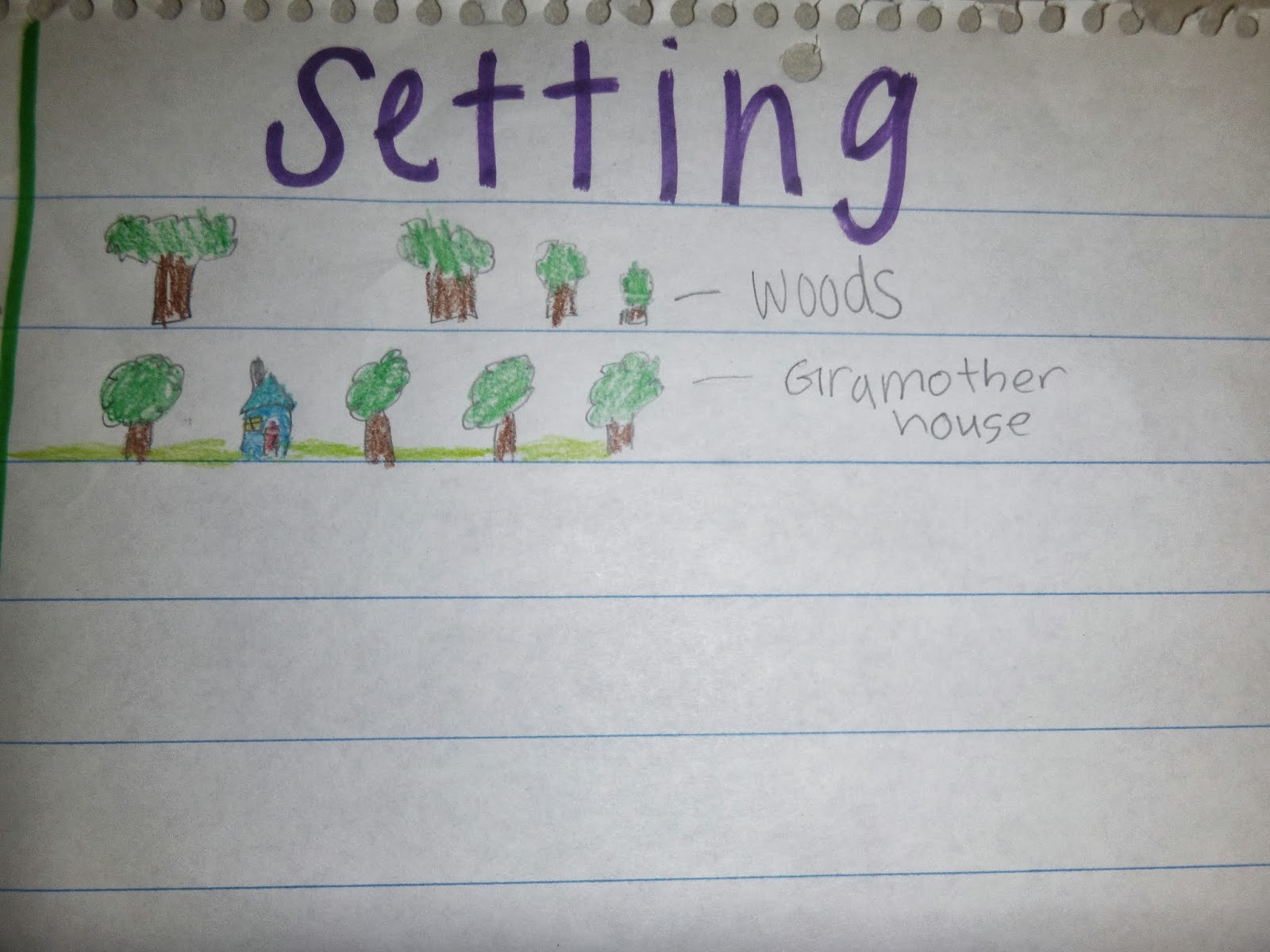
Task: Read the story. Complete a story map identifying the story elements and main character's point of view. Make a poster identifying the characters, setting, problem, and solution in the story. Show your poster to class and explain your writing/illustrations.




Group 4: Goldilocks and the Three Bears
Task: Read the story all the way through. Then, assign parts to each person in the group. Perform the fairy tale to the class as a reader's theatre. Generate questions to ask the class when you are finished performing the fairy tale.


More student pics...


In addition, we also read some mixed-up versions of fairy tales. We compared the main characters and discussed how the point of view changed between the stories.


There are many other versions that the students didn't get a chance to read in class. You can check out many of these at your local library. Here are a few suggested titles:
- Believe Me, Goldilocks Rocks!
-Snow White Was So Forgetful!
-Trust Me, Jack's Beanstalk Stinks!


